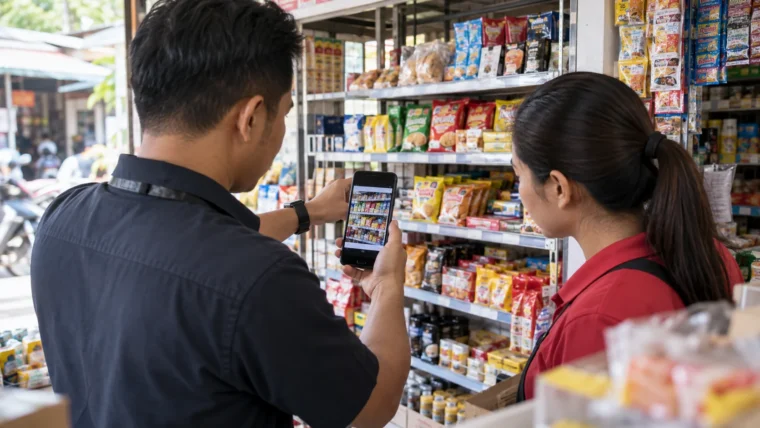

Store visit priority is a repeatable way to decide which outlets a field sales team visits, how often, and on what evidence. Score four inputs — customer segment, unresolved issues, stock signals and recent visit history — then apply written override rules. Priority decides which outlets deserve a visit; route planning decides the order you visit them in on a given day. Build the priority list first, then let routing sort it.
This method suits FMCG field sales and channel operations teams that need a defensible answer when a rep, a distributor or a key account asks why one outlet is on the plan and another is not. The thresholds below are illustrative; set your own with your team and your data.
Store visit priority and route planning solve different problems
Priority is a coverage decision, usually weekly or monthly: which outlets, how often, and what must be achieved there. Route planning is a sequencing decision, usually daily: in what order, given distance, traffic and service windows.
When the two are confused, the plan drifts. Reps re-sort the day by distance, high-value accounts slip down the list, and nobody can explain why. Keep the two artefacts separate: a published priority band per outlet, and a daily sequence built inside that band.
The four inputs behind a store visit priority decision
Keep the input set small enough that a rep can explain the outcome in one sentence.
| Input | What it tells you | Typical data source | Example rule |
|---|---|---|---|
| Customer segment or tier | Baseline importance and promised service level | Store master data in a sales force automation (SFA) or distributor management system (DMS) | Tier A at least twice a month; tier C at least once a quarter |
| Unresolved issues | Urgency a routine cycle would miss | Visit reports, complaint log, order exceptions | Any open issue older than 14 days moves the account up one band |
| Stock signals | Risk of lost sales or waste | Distributor inventory, store audit, order history | Key SKU out of stock, or cover below the agreed minimum, raises priority |
| Recent visit history | Whether the promised work actually happened | Check-in records, follow-up status | A missed visit or open follow-up from the last 14 days raises priority |
Two conditions apply. The same rules must produce the same band for the same outlet state, or the method is not transparent. The inputs must also be current enough to act on: a three-week-old stock figure is a history lesson, not a signal.
A decision table you can adapt
The inputs become four bands. The band sets the response time, not the exact day.
| Band | Typical signals | Target response | Who confirms |
|---|---|---|---|
| 1 — Immediate | Tier A or key account with an unresolved issue, or a key SKU out of stock | Within 48 hours or the next working day | Field sales manager approves |
| 2 — This week | Tier A or B with a due follow-up, or a distribution gap on a priority line | Inside the current week | Field sales manager plans with the rep |
| 3 — Next cycle | Stable tier B or C outlet, no open issue, stock within range | Next scheduled cycle for that tier | Rep follows the published cycle |
| 4 — Monitor | Low-potential or dormant outlet with no open work | No visit; phone contact or serve through the distributor, reviewed quarterly | Sales operations maintains the list |
Working example: a tier B outlet has no open complaint, but its main SKU has been out of stock for six days and the last visit was three weeks ago. Stock signal plus visit history places it in band 2 for this week — a clear, defensible instruction a rep can repeat to the owner.
Override rules that outrank the score
Every method needs written exceptions, or the exceptions become the method. Log each override with the reason, the approver and the date.
- Product recall, quality or safety concern: visit regardless of band.
- Contractual service commitment or new store opening: first visit inside the agreed window.
- Trade promotion launch or end-of-promotion check: promotion stores move up a band for the launch and the reconciliation visit.
- Escalated complaint from a key account or distributor principal: treat as band 1 until closed.
- Credit or payment hold: decide in writing whether a visit becomes a call, and who owns the conversation.
If overrides exceed roughly a fifth of the week in the same category, that category is probably a permanent input and belongs in the scoring table instead of the exception list.
Roles and ownership
| Role | Owns | Cadence |
|---|---|---|
| Field sales rep | Ground-truth flags, follow-up status, visit evidence with time, store and task | Daily |
| Field sales manager | Band rules, override approvals, workload balance across territories | Weekly |
| Sales operations | Store master data, reporting, metric definitions, exception log | Weekly |
| Channel operations or distributor liaison | Distributor stock feed, order exceptions, service-level gaps | Weekly |
Store managers may take part in the visit itself, but do not assume they use the same software or hold the same permissions as your team.
The weekly review
Hold one short review each week, covering the same items in the same order: band changes and their causes, override log, coverage against promised frequency, follow-ups past due, and data gaps.
For each metric, state the numerator, denominator, time period and exception policy before using it to judge anyone. Suggested measures:
- Scheduled versus completed visits, by territory and week.
- Follow-up completion: closed follow-ups divided by follow-ups raised.
- Required-field completeness: complete visit records divided by submitted records.
- Share of visits that changed a band or closed an open issue.
- Override count and reason mix, reviewed for patterns rather than blame.
These are evaluation measures, not guaranteed improvements. Choose the ones that match the decision you need to make.
Prerequisites and limitations
You need clean store and product identifiers, defined territories, assigned staff, written visit objectives and agreed reporting fields. Exact required fields depend on your implementation and on what your distributor can supply.
Expect gaps. Where stock data is unreliable, use labelled proxies such as order history, store audit observations and rep reports, and mark the value as estimated with its age. A check-in or photo alone does not prove a task was completed correctly; the record is stronger when it carries a time, a store, a task and a review status. If your evidence cannot carry those four elements, treat verification as an open question, not a solved one.
Common mistakes to avoid
- Letting the loudest request of the morning set the day, instead of the band table.
- Using sales value as the only input, so problem outlets stay invisible until they stop ordering.
- Publishing scores without recording who can approve an override.
- Assuming a check-in or photo proves execution quality.
- Letting master data go stale after closures, relocations and ownership changes.
- Calling the output a route plan, so reps re-sort by distance and the priority logic disappears.
Verification checklist before rollout
- Can two managers assign the same band to the same outlet state?
- Is visit frequency per tier written down and agreed with the distributor?
- Is every override logged with a reason, approver and date?
- Does each visit record carry a time, a store, a task and a review status?
- Is there a named owner for master data and the distributor stock feed?
- Does the weekly review include data gaps, not only results?
Where Airpalm fits
Airpalm publicly describes mobile visits, route planning, store audits, sales orders, inventory and promotion management (source: airpalm.com, checked 2026-10-09). If your priority rules depend on those records, ask for a demonstration using sample stores and visits, and confirm required data, permissions and integration scope before assuming a field exists. Airpalm does not publish a store-scoring algorithm, so treat the scoring model as yours to define and document.
Next step: agree the four inputs, band table and override list with your field sales manager and sales operations lead, run them for one week, then review the exception log. You can contact Airpalm to walk through your prioritization and visit-review requirements.
Frequently asked questions (FAQ)
How often should store visit priorities be recalculated?
Recalculate bands on a fixed weekly cycle, in the same meeting where you review coverage, and apply overrides as events happen. A weekly cadence keeps the plan explainable and gives reps time to prepare. Event-driven overrides cover recalls, escalations, new store openings and promotion windows. Write the cadence down with the owner and effective date.
What can we do if stock signals are unreliable?
Use labelled proxies such as order history, store audit observations and rep-reported shelf conditions, and mark the value as estimated with how old it is. Never present an estimate as a measured stock figure. Then put data completeness on the weekly review agenda so the gap is fixed at source rather than absorbed by the reps.
Should every store get the same visit frequency?
No. Frequency should follow the segment and the open work. A common pattern is higher frequency for tier A and key accounts, and a lighter cycle for low-potential outlets served by phone or through the distributor. Set the minimum service level per tier in writing so reps are not improvising store by store.
Does prioritization make route planning unnecessary?
No, because they answer different questions. Priority defines which outlets deserve a visit and how often; routing decides the sequence and time budget for the day, taking distance and service windows into account. Build the priority list first, then let routing order it inside each band.
Put this guide into practice
This general-purpose worksheet is a starting point. Adapt its fields, responsibilities and rules to your business process.