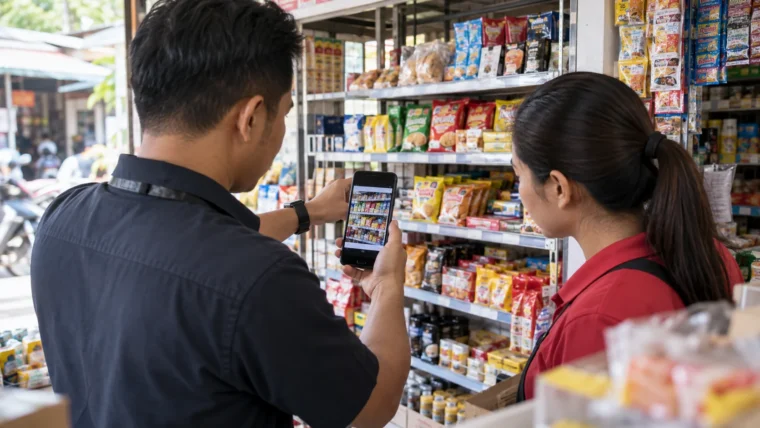

Direct answer: To set store visit frequency for FMCG field sales, assign each store a service segment, a default visit cadence and a documented exception rule. Use four inputs: physical service requirements, replenishment rhythm, customer commitments and observable changes such as stockouts or display gaps. Review the rules on a fixed cadence rather than changing them visit by visit. The intervals below are illustrative examples, not universal standards.
A frequency rule answers how often a store should be visited in a normal month. It does not answer which store a representative visits first today; that is route sequencing.
How to set store visit frequency in five steps
- Assign each store a service segment based on what must happen at the store and how often it changes.
- Set a default cadence for each segment, using a consistent unit such as visits per month.
- Write exception rules before the cycle begins, with a reason, owner and expiry date.
- Record the segment, current cadence, proposed cadence, reason and next review date in a worksheet.
- Review open exceptions monthly and segment defaults quarterly; test extra visits against stated measures.
Make the store visit frequency rule explicit
Without a written rule, frequency drifts. High-maintenance stores get extra visits after a complaint, quiet stores get dropped, and no one can explain the pattern later. Define three things: a default cadence for each store segment, a short list of approved exceptions, and an owner who reviews whether the pattern still fits store needs. Record the segment, current cadence, proposed cadence, reason and next review date so a new manager or representative can follow the same logic.
Segment stores using four frequency drivers
Segment by service need, not store size alone. Size may correlate with volume, but visit frequency should reflect what must happen in the store and how often it changes.
| Frequency driver | Question to answer | Evidence to record | How it can affect cadence |
|---|---|---|---|
| Service requirements | Which tasks must be done in-store, and how often? Consider shelf checks, display setup, audits or stock counts. | Task list, required evidence, store format and fixtures | Regular merchandising tasks may need a shorter interval than a stock-and-order check. |
| Replenishment rhythm | How often does the store order, receive stock and risk a stockout? Consider shelf life and demand variation. | Order cycle, delivery days, stock cover and recent exceptions | Fast replenishment or low stock cover can justify more checks; stable stock with reliable data may support a longer interval. |
| Customer commitments | What has been agreed with the retailer or channel? Consider service promises, promotion periods and account plans. | Agreement notes, promotion calendar, service level and account owner | A commitment or active promotion can create a temporary cadence; an old promotion should not justify a permanent pattern. |
| Observable changes | What has changed that alters the service need? Examples include a new listing, display gap, repeated stockout or new store manager. | Visit notes, issue history, permitted photos and follow-up status | Escalate for a defined period with an expiry, then return to the default when the issue is closed. |
For illustration only, a team might test weekly, fortnightly and monthly defaults across three service segments. These are examples, not benchmarks. A small store with stable stock might sit on a longer cycle; a store with an active display programme might be reviewed more often. Keep three to five segments so the rule is easy to administer.
Use consistent store IDs, product IDs, territories, assigned staff and visit objectives so the same population can be reviewed over time.
Use a frequency-review worksheet
At minimum, record:
- store ID, format, territory and account owner;
- service segment and default cadence;
- current and proposed cadence in one consistent unit;
- reason code and supporting evidence;
- owner, approver, effective date and expiry;
- review outcome and next review date.
Assign roles. A field sales manager can own the territory pattern; sales operations can maintain segment rules and reporting; the account owner supplies store context; a channel lead approves changes tied to customer commitments or promotions. Review open exceptions monthly and segment defaults quarterly, adapting the cadence to how quickly your channel plan changes.
Set exception rules and test whether extra visits help
Write exception rules before the cycle begins. A temporary uplift may fit a new listing, promotion launch, repeated stockout or display correction. A temporary reduction may fit a store closure or an information-only check with reliable remote follow-up. Every exception needs a reason, owner and expiry date.
To test extra visits, state the hypothesis and measure in advance. Suggested measures include scheduled visits, completed visits, required-field completeness and follow-up completion. Define the numerator, denominator, period and exception policy. A rise in completed visits does not prove better execution; compare similar stores where possible and acknowledge the limits of a small or uncontrolled test.
Remote follow-up can be sufficient for confirming a delivery date, collecting a routine stock update from reliable records or closing a non-urgent administrative question. It is usually weak when the objective requires physical observation, display correction, stock counting or an in-store discussion. Decide by task, not by a general preference for fewer visits.
Give failed visits a reason code. Repeated closures, access problems or reschedules should feed the frequency review rather than disappear as unexplained gaps. The reason codes for failed store visits guide and this guide to measuring store visit quality can help.
Where Airpalm fits
Airpalm publicly describes mobile visits, route planning, store audits, sales orders, inventory and promotion management. Source: airpalm.com, checked 2026-10-09. That describes visit activity and store-level evidence, not a prescribed cadence for your stores. Set the segment rules and exception owners first, then evaluate whether the workflow supports them. Ask for a demonstration using your sample stores and confirm required data fields, permissions and mobile environments. For context, see sales force automation (SFA) in FMCG field sales. A sensible next step is to draft one segment table and exception list for a single territory and review it for a month.
Frequently asked questions (FAQ)
How often should an FMCG field sales team visit a store?
There is no universal interval. Set a default cadence by service segment, then add dated exceptions for service requirements, replenishment rhythm, customer commitments and observable changes. Review the pattern against store evidence.
Can remote follow-up replace a store visit?
Sometimes. It can be enough for routine information collection or confirming an administrative status when reliable records exist. It is usually not enough when the objective requires physical observation, display correction, stock counting or an in-store discussion.
Who should approve changes to store visit frequency?
Use a named owner for the territory and an approver for exceptions. A field sales manager may own the pattern, sales operations may maintain rules and reporting, and a channel lead should approve changes tied to customer commitments or promotions. The exact split depends on the organisation.
How do we test whether extra visits are worthwhile?
State the hypothesis and measure before changing the pattern. Track scheduled and completed visits, required-field completeness, follow-up completion and the specific store issue you expect to improve. Compare similar stores where possible and avoid treating more visits as proof of better execution.
Put this guide into practice
This general-purpose worksheet is a starting point. Adapt its fields, responsibilities and rules to your business process.