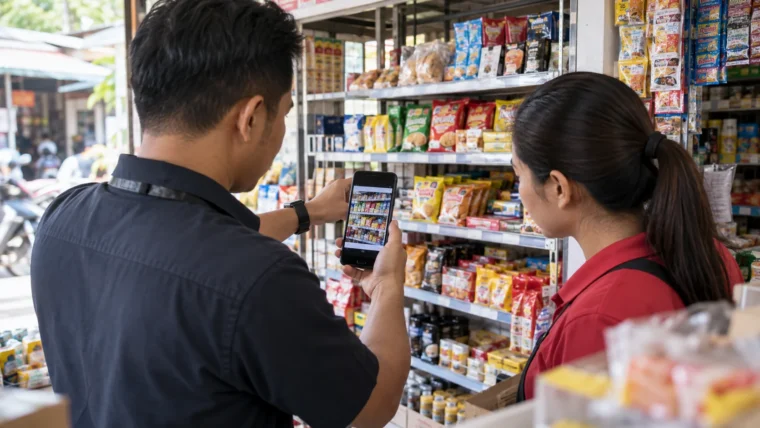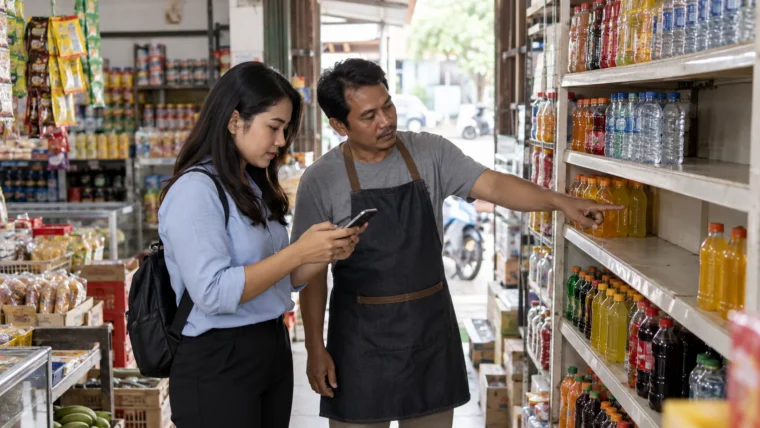

SFA (sales force automation) in FMCG field sales is software that plans, guides and records the work a field sales team does in stores. It turns a working day into a structured sequence: agree the route, arrive at the outlet, complete assigned tasks, record what was observed, capture orders, and close follow-up actions before the next visit. It is a field execution workflow and evidence system, not a general customer database.
This article explains who uses SFA, the visit cycle it covers, how it differs from adjacent systems such as CRM, DMS and TPM, and what to check before adopting it.
How SFA structures FMCG field sales: step by step
Definitions vary by vendor, but the operating core is a visit cycle. The steps below describe common field execution practice; they are not a confirmed module list for any particular product.
- Plan the route and visit. Territories are split into call cycles, and outlets are assigned to representatives and days. The plan sets which stores are due, the objective for each one, and the tasks to complete.
- Execute assigned tasks in store. At the outlet, the representative works through tasks such as shelf and display checks, stock counts, pricing checks, availability or planogram observations, and promotion execution items.
- Capture orders and inventory information. Orders, stock positions and competitor observations are recorded on the spot. This is often where SFA meets order capture and distributor supply.
- Follow up and review. Open actions, such as an out-of-stock to escalate or a damaged display to replace, carry forward to the next visit or to a supervisor. Managers review completion, data quality and exceptions rather than raw visit counts alone.
Who uses SFA in FMCG field sales?
Typical users are field sales managers, sales operations teams and channel leaders in consumer goods companies and their distributors. Field representatives execute the workflow in stores. Store managers often take part in the conversation or place the order, but they usually do not use the same software or hold the same permissions, so a shared login model should not be assumed.
SFA compared with CRM, DMS and TPM
SFA overlaps with several adjacent systems in consumer goods. The table below outlines the primary question each system answers and where the overlap usually occurs.
| System | Primary question it answers | Typical owner | Where it overlaps with SFA |
|---|---|---|---|
| Sales force automation (SFA) | What should each field representative do in each store, and what actually happened? | Sales operations, field sales management | Core field workflow and store-level evidence |
| Customer relationship management (CRM) | Who is the account, and what is the history of the relationship? | Sales and marketing leadership | Account and contact records, visit history |
| Distributor management system (DMS) | What stock, orders and settlements move through the distributor network? | Distributor and channel operations | Orders captured in store, outlet master data |
| Trade promotion management (TPM) | Which promotions run, at what cost, and what did they deliver? | Trade marketing, finance | Promotion execution checks at store level |
These categories overlap in real deployments and are not mutually exclusive. A CRM may hold visit history, a DMS may hold the outlet master and the order, and a TPM may need store-level proof that a promotion ran. The useful question is not which label is correct, but which problem you are trying to solve first. For a closer look at the promotion side, see the explanation of trade promotion management.
Illustrative example: a week in a distributor field team
The scenario below is illustrative and does not describe any specific implementation. A distributor covers 400 outlets with eight representatives. Each representative has a five-day call cycle, with 12 to 15 outlets per day and a primary objective for each outlet: availability, display, price compliance or order capture.
On Monday the plan is reviewed and exceptions from last week are carried over. During the week, each completed visit produces a store record with the tasks attempted, stock and shelf observations, and any order placed. On Friday the supervisor reviews the week by exception: which target outlets were not visited, which required fields are missing, and which follow-up actions are still open. The value in this example comes from the structure and the review loop, not from the volume of data collected.
Data and setup prerequisites
Required fields depend on the actual implementation, so treat the list below as a starting checklist for scoping:
- Customer and store IDs, with a clear definition of what counts as a unique outlet
- Product IDs and the units or cases used for ordering and stock
- Territory structure and call-cycle assignments
- Which staff are assigned to which outlets, and with what permissions
- Visit objectives and the tasks that must be completed for each objective
- Reporting fields, including which ones are mandatory and which are optional
How to judge whether visit evidence is meaningful
A photo or a check-in on its own does not establish that a task was performed correctly. A more useful editorial test asks whether each piece of evidence carries a time, a store, a task and a review status. If any of those four elements is missing, the record supports presence but not execution quality.
Suggested pilot measures
If you pilot SFA, state the numerator, denominator, time period and exception policy for every measure before you start.
| Measure | How to calculate it | Why it matters |
|---|---|---|
| Scheduled visit completion | Completed visits divided by visits scheduled in the period, with closed or cancelled stores handled by a stated policy | Shows whether the plan is realistic and whether it is followed |
| Required-field completeness | Visits with all mandatory fields captured divided by completed visits | Shows whether the data is usable for review |
| Follow-up completion | Follow-up actions closed by the due date divided by actions created in the period | Shows whether the visit cycle actually closes |
| Target outlet coverage | Target outlets visited at least once in the period divided by target outlets on the list | Shows whether the call cycle reaches the stores that matter |
These are suggested evaluation measures, not guaranteed improvements.
Questions to ask before adopting SFA
- Can the vendor demonstrate the workflow using your own sample stores and visit data rather than a generic demo dataset?
- Which mobile environments and device types are supported?
- Which data fields are mandatory, and how does the system handle incomplete visits?
- What are the user roles and permissions for representatives, supervisors and head office?
- What integration scope is agreed for orders, outlet master data and promotion records?
- What happens when a representative is offline or a visit is interrupted?
- Which reports are produced, and who reviews exceptions?
Limitations: what SFA does not do
SFA structures field execution and captures store-level evidence. It does not replace account strategy, negotiation skill or commercial judgement. It does not repair poor outlet or product master data, and it does not by itself prove that a display was built correctly. SFA is also not the same as financial stock accounting, credit control or settlement, which distributors typically handle in a DMS or ERP. Treat automation as a way to make an agreed process visible and reviewable, not as a substitute for the process.
Where Airpalm fits
Airpalm publicly describes mobile visits, route planning, store audits, sales orders, inventory and promotion management (source: airpalm.com, checked 9 October 2026). If you are evaluating SFA for FMCG field sales, that public scope is the relevant starting point. Confirm supported mobile environments, required data, permissions and integration scope in a demonstration using your own sample stores and visits. You can start at Airpalm, read the related walkthrough What Is Sales Force Automation (SFA)? How SFA Works in FMCG, or browse topics such as FMCG field sales and retail execution.
Frequently asked questions (FAQ)
Is SFA the same as CRM?
No, though they overlap. The practical split is the problem being solved: CRM centres on the account, the relationship and its history, while SFA centres on guided field execution and store-level evidence of what happened during a visit. Many systems hold some of both, so the categories are not mutually exclusive, and one does not replace the other in every business.
Does SFA replace a distributor management system?
Usually not. SFA covers the field workflow and can capture orders and stock observations at the outlet, but distributor stock accounting, credit control and settlement are typically handled in a DMS or ERP. Where the two meet is order capture and outlet master data, so define that boundary early in scoping.
Does a photo or a check-in prove that a task was done correctly?
No. A photo or a location check-in shows presence at a place and time, not correct execution. A stronger test is whether the record carries a time, a store, a task and a review status, and whether a supervisor reviews exceptions rather than accepting raw visit counts.
What data do you need before starting an SFA rollout?
At minimum you need customer and store IDs, product IDs, territory and call-cycle assignments, staff-to-outlet assignments, visit objectives with the tasks behind them, and a defined reporting field set. Which fields are mandatory depends on the actual implementation, so confirm that during scoping rather than assuming a standard template.
Put this guide into practice
This general-purpose worksheet is a starting point. Adapt its fields, responsibilities and rules to your business process.